Breast Implant Revision
Breast implants are excellent devices, but they are not lifetime devices — and neither is the decision you made about them years ago. The FDA notes that many women with implants will have at least one additional breast operation over their lifetime, whether for a medical reason like capsular contracture or rupture, or simply because what they want has changed. Today the most common change of heart runs in one direction: patients who were augmented ten or twenty years ago increasingly return asking for something smaller, softer, and more natural. Breast implant revision covers all of it — exchanging implants for a new size or style, correcting problems, lifting stretched tissue over new implants, or removing implants altogether. Dr. Rafizadeh has performed breast implant surgery in Morristown, NJ since 1984, and revision is where those four decades matter most.
“A first augmentation is a fresh canvas. A revision never is — there is a capsule, a stretched envelope, an old scar, and a patient who has already been disappointed once or has simply changed. The operation has to be diagnosed before it is planned: is the problem the implant, the pocket, the capsule, or the skin? Each has a different fix, and the honest answer is sometimes a smaller implant with a lift — or no implant at all.”
— Dr. Farhad Rafizadeh, MD FACS

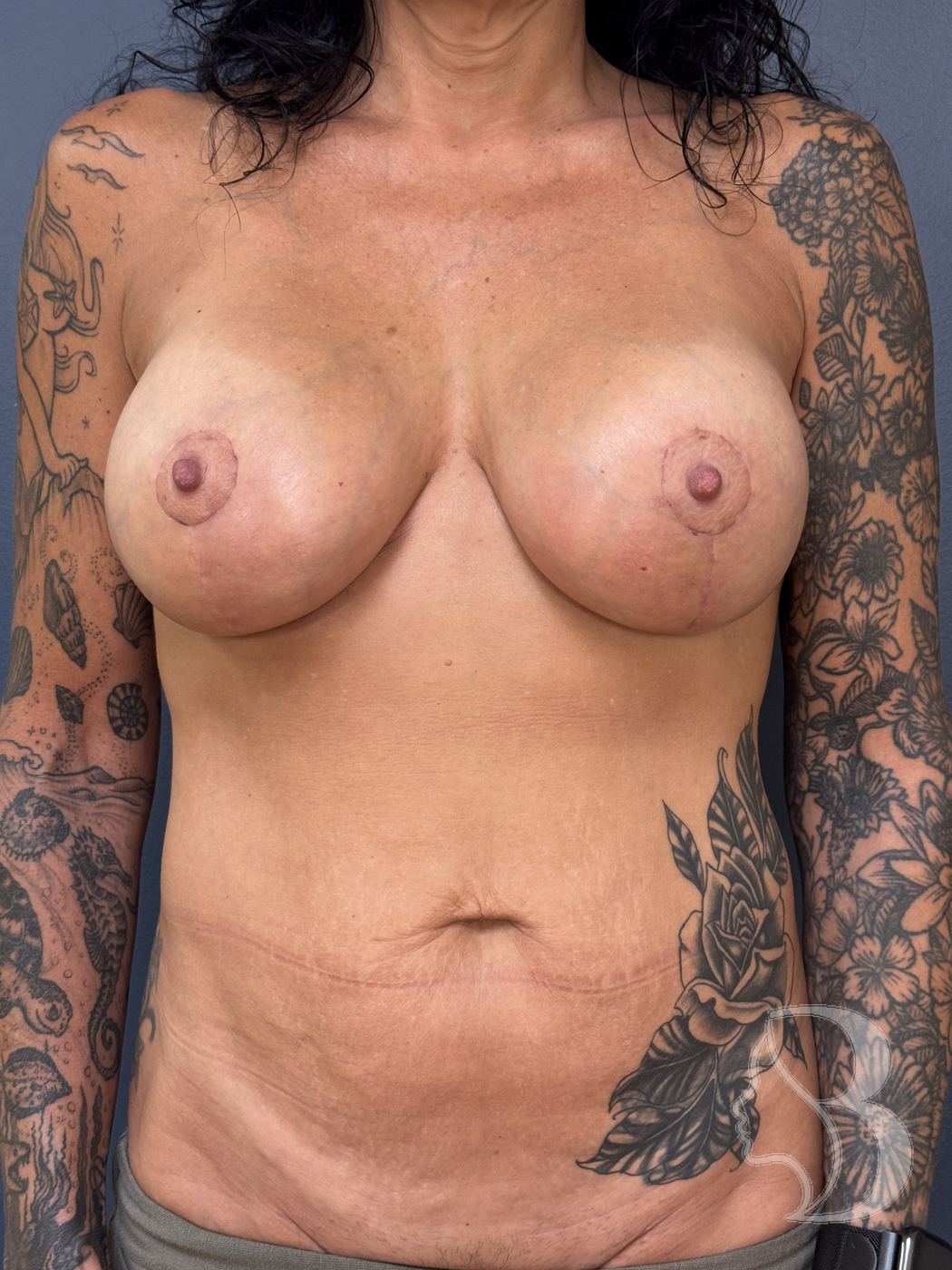
Implant Revision Before & After
View Full Gallery →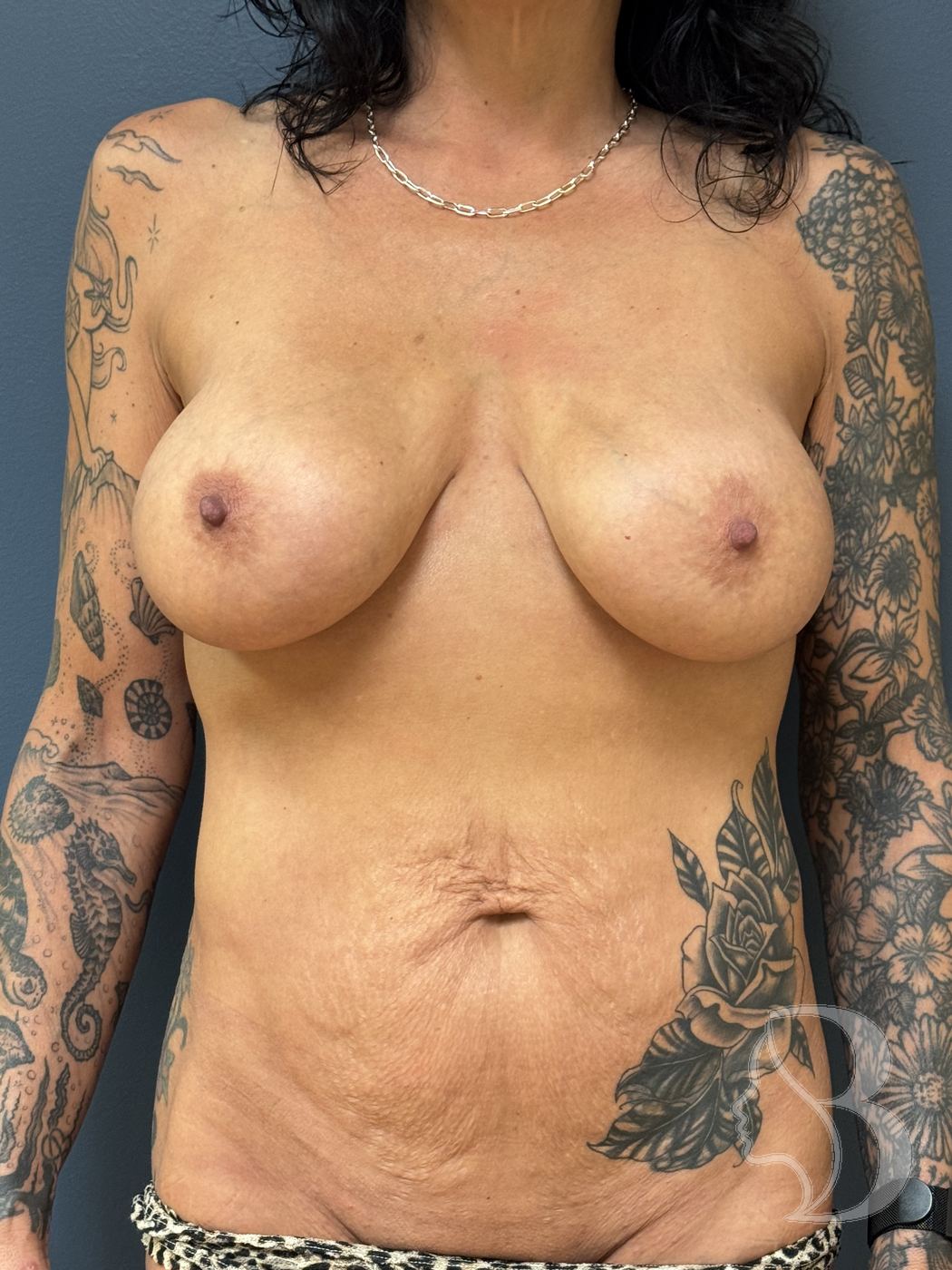


Why Patients Seek Revision
Some reasons are medical. Capsular contracture — tightening of the scar capsule around the implant — can make the breast feel firm, look distorted, or ache. Rupture deflates a saline implant visibly, while a silicone rupture is often silent and found on screening. Malposition — an implant that has bottomed out, drifted to the side, or moved toward the midline — changes the breast’s shape and nipple position. Visible rippling shows through thin tissue. And some reasons are simply personal: a size chosen at 25 that no longer fits life at 45, breasts that have changed with pregnancy, weight, or time over an implant that hasn’t, or old-generation implants a patient wants exchanged for modern devices — Dr. Rafizadeh uses Motiva, Allergan, and Mentor implants, and never textured devices. For how implant age factors in, see his article on how long breast implants last and when to replace them.
Your Options
Revision is not one operation — it is a menu, and most patients need only part of it.
The existing implants are replaced through the original scar with a new size, profile, or style — larger, smaller, saline to silicone, or older devices to modern Motiva, Allergan, or Mentor implants. Downsizing is the fastest-growing request.
When the skin has stretched — from a large implant, pregnancy, or time — an exchange alone leaves a deflated look. Adding a breast lift retailors the envelope over the new implant for a shape that actually matches the size change.
Capsulectomy or capsule release for contracture, internal pocket repair for bottoming-out or lateral drift, and fat grafting to camouflage rippling or thin coverage — alone or combined with an exchange.
The Honest Part: Exchange vs. Lift vs. Removal
The most common planning mistake in revision surgery is swapping the implant when the implant was never the problem. If the breast has dropped and the implant hasn’t, a new implant — any new implant — still sits high over descending tissue; that patient needs a lift, with or without an exchange. If the goal is dramatically smaller, the stretched envelope almost always needs tailoring, not just a smaller filler. And for some patients the right answer is no implant at all: implant removal (explant), optionally with a lift or with fat transfer to restore a modest, natural volume. Dr. Rafizadeh has no stake in which one you choose — his job at consultation is to match the operation to your tissue and your goal, and to tell you plainly when the smaller operation, or the bigger one, is the one that will actually work.
→ Schedule a ConsultationMeet with Dr. Rafizadeh personally to discuss your implants, your goals, and a personalized revision plan. Call (973) 267-0928 or request a consultation online.The Procedure & Recovery
Revision surgery is performed as an outpatient procedure under general anesthesia, almost always through the existing inframammary scar — no new visible incision. A straightforward exchange takes about an hour; capsule work, pocket reconstruction, or a simultaneous lift extends the operation to two to three hours. Because the pocket already exists, recovery from a simple exchange is usually easier than the first augmentation: most patients are back at desk work in three to five days, with exercise phased in over four to six weeks. Bigger corrections heal on a longer curve, and Dr. Rafizadeh is specific with each patient about what their particular plan means for their particular week.
Two practical notes worth knowing before any consultation. First, warranties: Allergan, Mentor, and Motiva all back their implants with lifetime product replacement and, in roughly the first ten years, a contribution toward surgical costs for qualifying rupture — bring your implant card if you have it. Second, insurance sometimes participates: revision for contracture with rupture, or revision of implants placed during breast reconstruction, may be covered in part. Neither is guaranteed, but both are checked as part of planning.
Breast Implant Revision in New Jersey
Dr. Rafizadeh cares for revision patients from across New Jersey — Morris, Essex, Union, Somerset, Bergen, and Passaic counties — as well as patients traveling from New York City, including many whose original surgery was performed elsewhere. Revision consultations are unhurried by design: he reviews your original records when available, examines the implant, capsule, and skin separately, orders imaging when rupture is in question, and walks you through the honest trade-offs of exchange, lift, fat transfer, and removal before recommending a plan.
Sources & References
- U.S. Food & Drug Administration. “Breast Implants: Risks and Complications.” fda.gov
- U.S. Food & Drug Administration. “Breast Implants — Screening for Silicone Gel-Filled Breast Implant Rupture.” fda.gov
- American Society of Plastic Surgeons. “Breast Implant Revision.” plasticsurgery.org
- American Society of Plastic Surgeons. “2024 Plastic Surgery Statistics Report.” plasticsurgery.org
- Handel N, Cordray T, Gutierrez J, Jensen JA. “A long-term study of outcomes, complications, and patient satisfaction with breast implants.” Plastic and Reconstructive Surgery. 2006;117(3):757–767. PubMed
- American Board of Plastic Surgery. “Verify a Surgeon’s Certification.” abplasticsurgery.org