
One of the most clarifying questions Dr. Farhad Rafizadeh receives from patients in his Morristown consultation room — and one he answers frequently on his RealSelf Q&A page — comes from patients who are ready for a facelift but notice something else is wrong: their cheeks have lost volume, and they wonder whether fat transfer should happen at the same visit or a separate one.
“I’m considering a facelift but my cheeks and under-eye area look deflated. Should I get fat transfer done at the same time as the facelift, or is that too much at once? Would it be better to do them in stages?”
It is exactly the right question to be asking — and the answer Dr. Rafizadeh gives after four decades of facial surgery in Northern New Jersey is unambiguous: do both at the same time. Not because of convenience, but because facial aging is two problems happening simultaneously, and separating the solutions serves neither one well.
The Two-Problem Nature of Facial Aging
Facial aging is commonly misunderstood as a skin problem — tissue that has drooped and needs to be tightened. That framing is partially correct. Jowls, neck laxity, and descended cheek tissue are all gravity-driven changes that a deep plane facelift addresses elegantly. But beneath the sagging skin, something else is happening: the fat compartments of the face are shrinking.
The midface fat pads — particularly the buccal fat, sub-orbicularis fat, and periorbital fat — diminish with age. The result is a face that, even after a technically excellent facelift, can look gaunt, hollowed, or “operated” because tightened skin has been stretched over a skeleton that now has less volume beneath it. This is the “wind-tunnel” look that patients rightly dread. It is not caused by pulling skin too tight — it is caused by lifting skin over a deflated underlying structure.
The solution is to restore what was lost. And the best material for that restoration is the patient’s own fat.
Dr. Rafizadeh’s Answer
I routinely combine fat transfer with facelift surgery. The facelift addresses the laxity — the jowls, the neck, the descended midface — and the fat transfer restores the volume that age has removed. Doing them at the same time makes surgical and practical sense. The tissues are already mobilized, the patient is already under sedation, and the recovery for both overlaps completely. Staging them means a second procedure, a second recovery, and no advantage to the patient. I use fat harvested from the abdomen or thighs, processed to isolate the fat cells, and injected in small increments into the cheeks, temples, and under-eye area depending on where volume has been lost. The result is a face that looks lifted and full — which is what a younger face actually is.
What Fat Transfer Does That a Facelift Cannot
A facelift — even a deep plane facelift, which releases the facial ligaments at their root and repositions the underlying SMAS layer — is a lifting and repositioning procedure. It moves tissue back toward where it was. It does not add tissue. It cannot restore the fat that has been metabolized and gone.
Fat transfer does exactly that. Fat is harvested from a donor site — typically the abdomen or inner thighs via small-cannula liposuction — processed to remove the oil and water fractions and concentrate the viable fat cells, and then injected into the face in tiny aliquots at multiple depths. Each aliquot is deposited along a withdrawal track so that the fat is distributed in threads rather than boluses, maximizing contact with surrounding tissue and improving survival.
The combination delivers what neither procedure could achieve alone: a face that is both lifted and full, with natural contours, natural movement, and natural aging going forward.
Why Combining Them Is Surgically Sound
Some surgeons advise patients to stage fat transfer and facelift separately, citing concerns about disrupting the fat graft during facelift dissection. This concern, while theoretically plausible in a simplified model, does not hold up in experienced hands. The key is sequencing: Dr. Rafizadeh performs the facelift first, establishing the new tissue position, and then injects the fat into the repositioned facial architecture. The fat is placed in zones that are not undermined during the facelift — particularly the central midface, the malar eminence, the tear trough, and the temples — so there is no conflict between the two procedures.
Studies in the plastic surgery literature have confirmed that fat graft survival rates in simultaneous facelift cases are comparable to standalone fat grafting cases. The concern about disruption is largely theoretical when proper technique is followed.
Where Fat Transfer Is Placed During a Facelift in North Jersey
In Dr. Rafizadeh’s Morristown practice, fat transfer during a facelift is concentrated in the areas most commonly depleted by aging:
- Malar (cheek) eminences — the high points of the cheeks that define facial structure and become flat with age
- Submalar hollows — the area just below the cheekbone that caves inward as the buccal fat pad shrinks
- Tear trough and infraorbital hollow — the transition from lower eyelid to cheek, where shadows create a tired, aged appearance
- Temporal hollowing — the indentation at the temples that makes the skull appear more visible with age
- Nasolabial and marionette region — where volume loss deepens the folds even after they are softened by lifting
The amount of fat transferred is modest — typically three to ten cubic centimeters per side, depending on the degree of depletion. Overfilling is one of the most common mistakes in facial fat grafting; Dr. Rafizadeh’s philosophy is to restore, not to overfill, with the understanding that some resorption is expected and the surviving fat will provide natural, lasting fullness.
Recovery: What to Expect When Both Are Done Together
The recovery from a combined deep plane facelift and fat transfer in Northern New Jersey follows the facelift timeline, not a combined timeline. Fat transfer does not meaningfully extend recovery beyond what the facelift alone would require. Patients should expect:
Week One
Bruising and swelling are present from both procedures. The fat transfer adds some additional puffiness to the central face that is distinct from facelift swelling. Drains (if used) are removed in the first few days. Most patients rest comfortably at home and are ambulatory from the first day.
Weeks Two and Three
Swelling from the facelift resolves more quickly than from the fat transfer. Patients from Morristown, Summit, Chatham, Madison, and other Northern New Jersey communities typically feel comfortable being seen in public — at a low-key social engagement — by the end of the second week, though residual puffiness from the fat transfer may persist.
Month One to Three
Fat resorption occurs during this period. Patients see their cheeks look somewhat “over-full” in the first few weeks as the fat settles, then gradually normalize as resorption occurs. By the three-month mark, the surviving fat has established its blood supply, and the result becomes stable. Patients are often pleasantly surprised at how natural the fullness appears once the acute swelling has resolved.
Six Months and Beyond
The final result — both the facelift lift and the fat graft volume — is visible and stable. Because fat is living tissue, it ages with the patient naturally. Unlike fillers, which require periodic re-injection as they dissolve, the surviving fat transfer is permanent. Patients from Summit, Short Hills, Florham Park, Bernardsville, and across Morris County who had fat transfer with their facelift rarely need volume supplementation for years afterward.
Patient Before & After
View Full Gallery →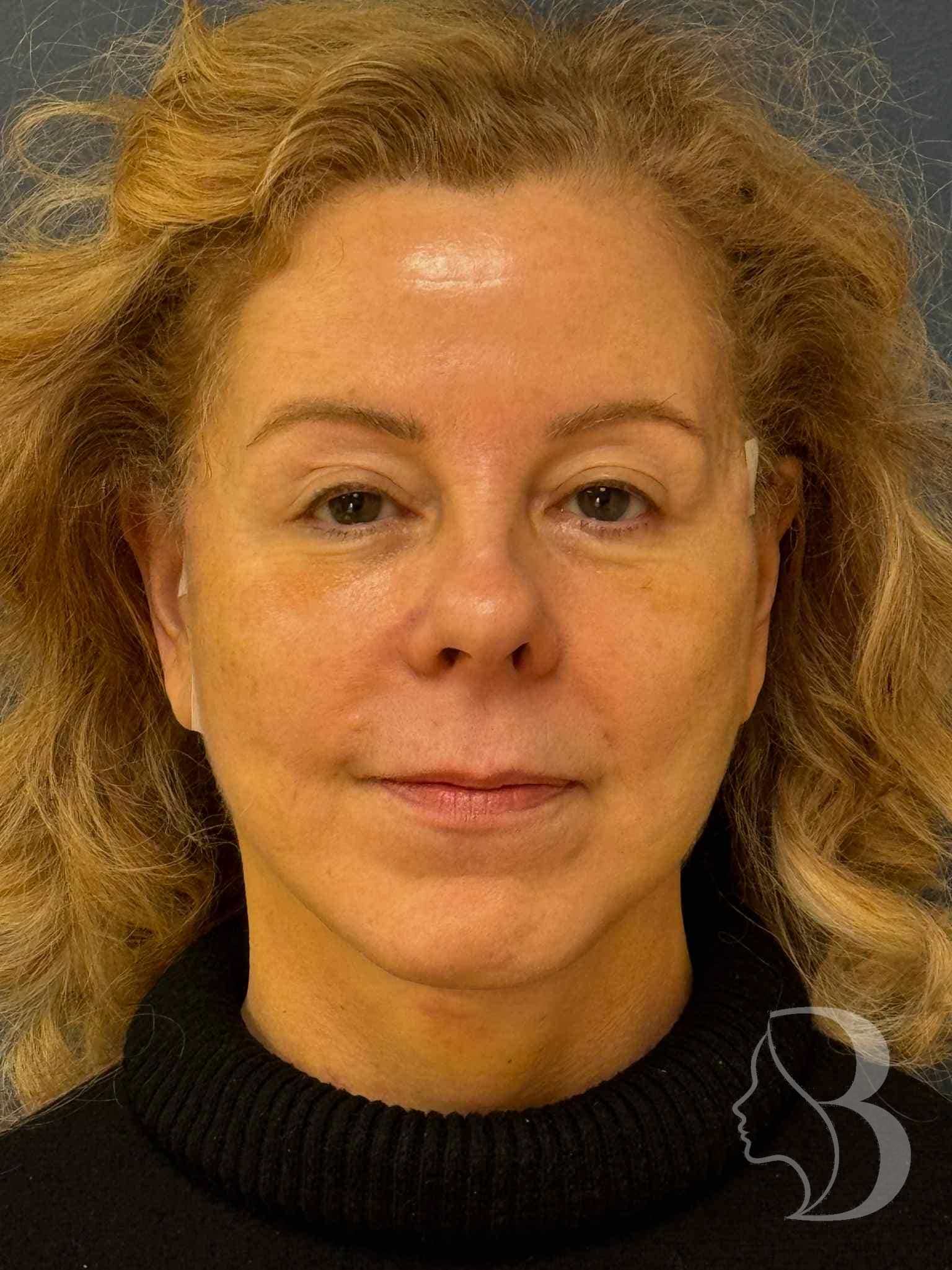
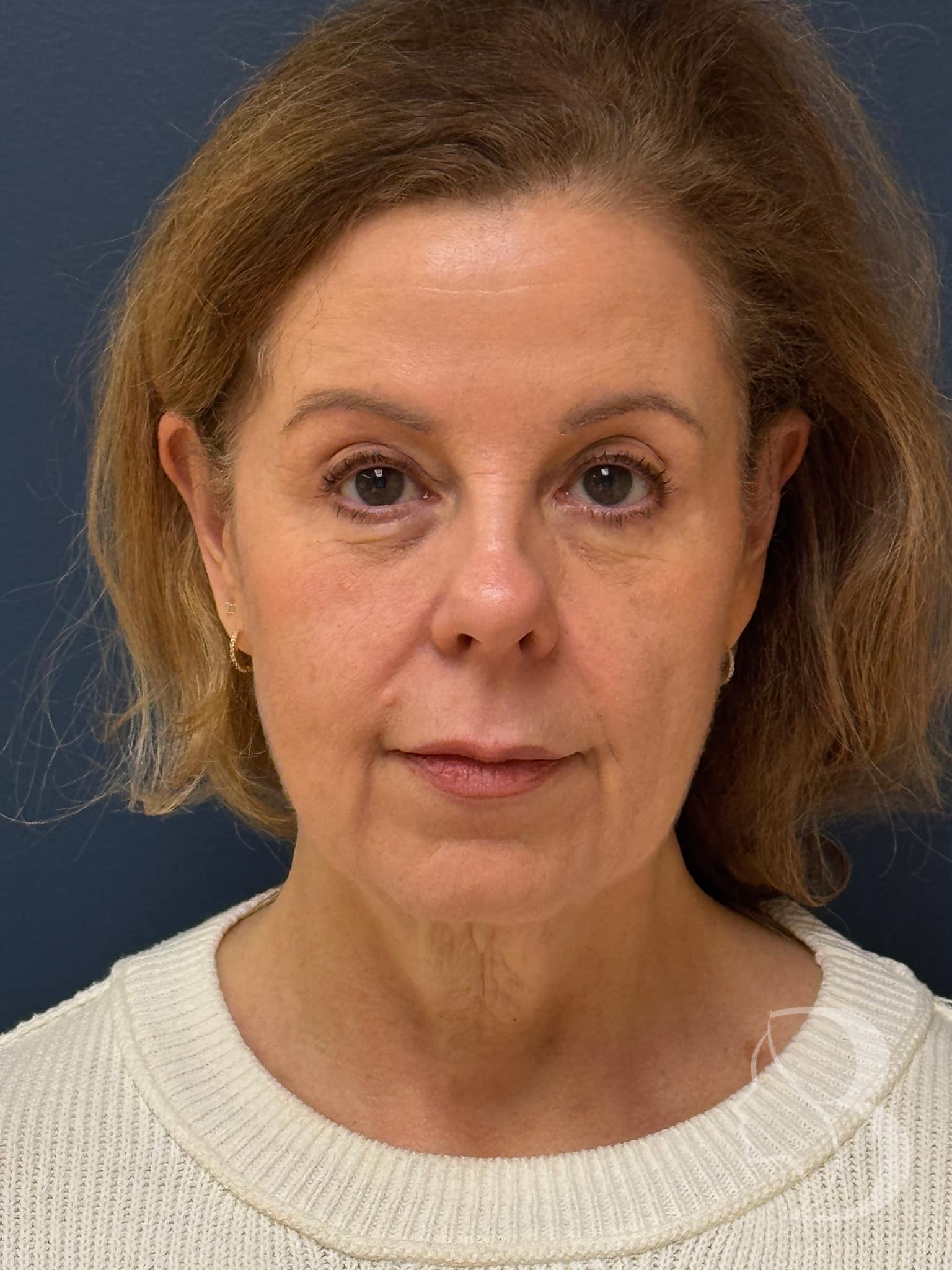
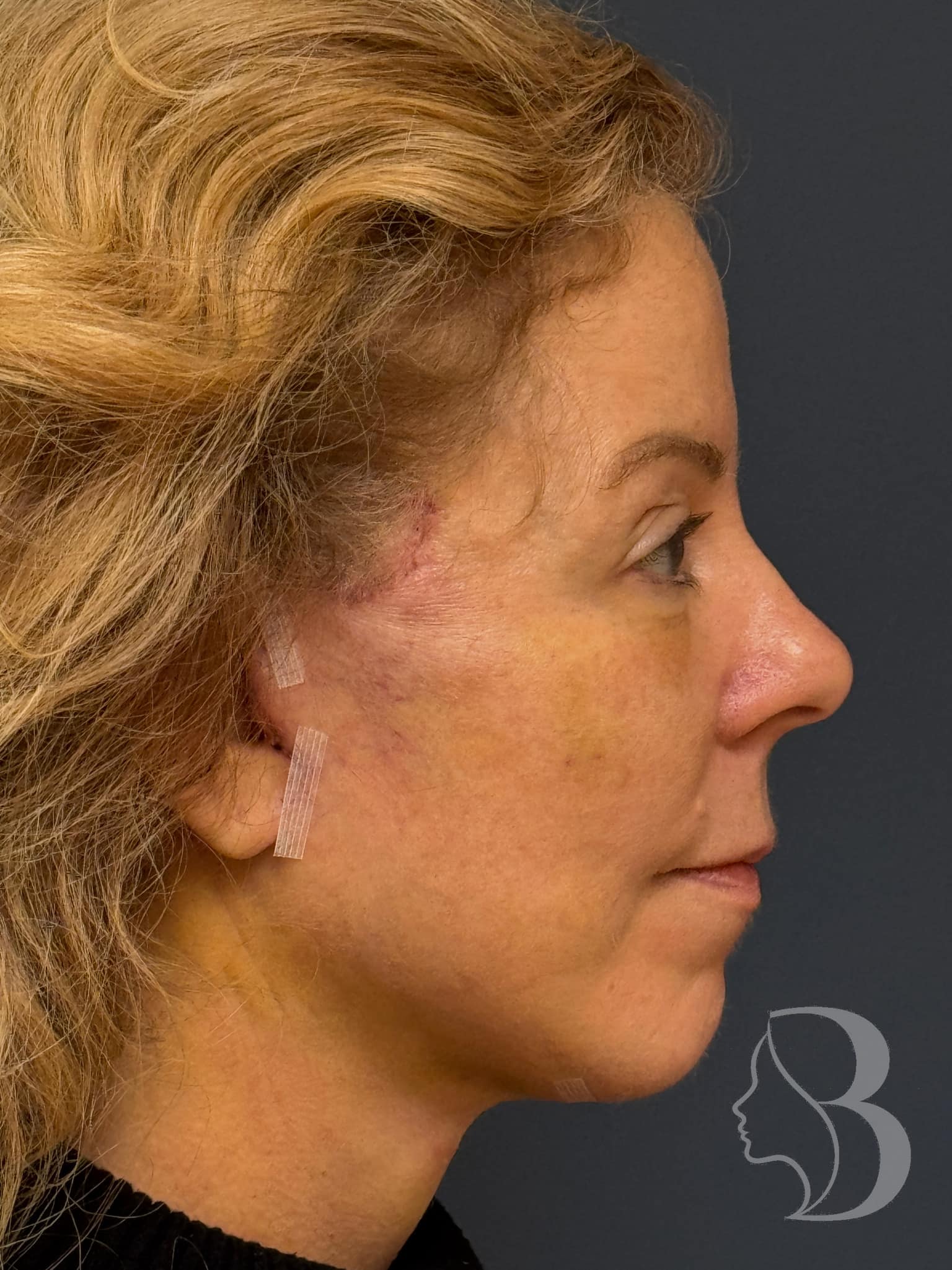
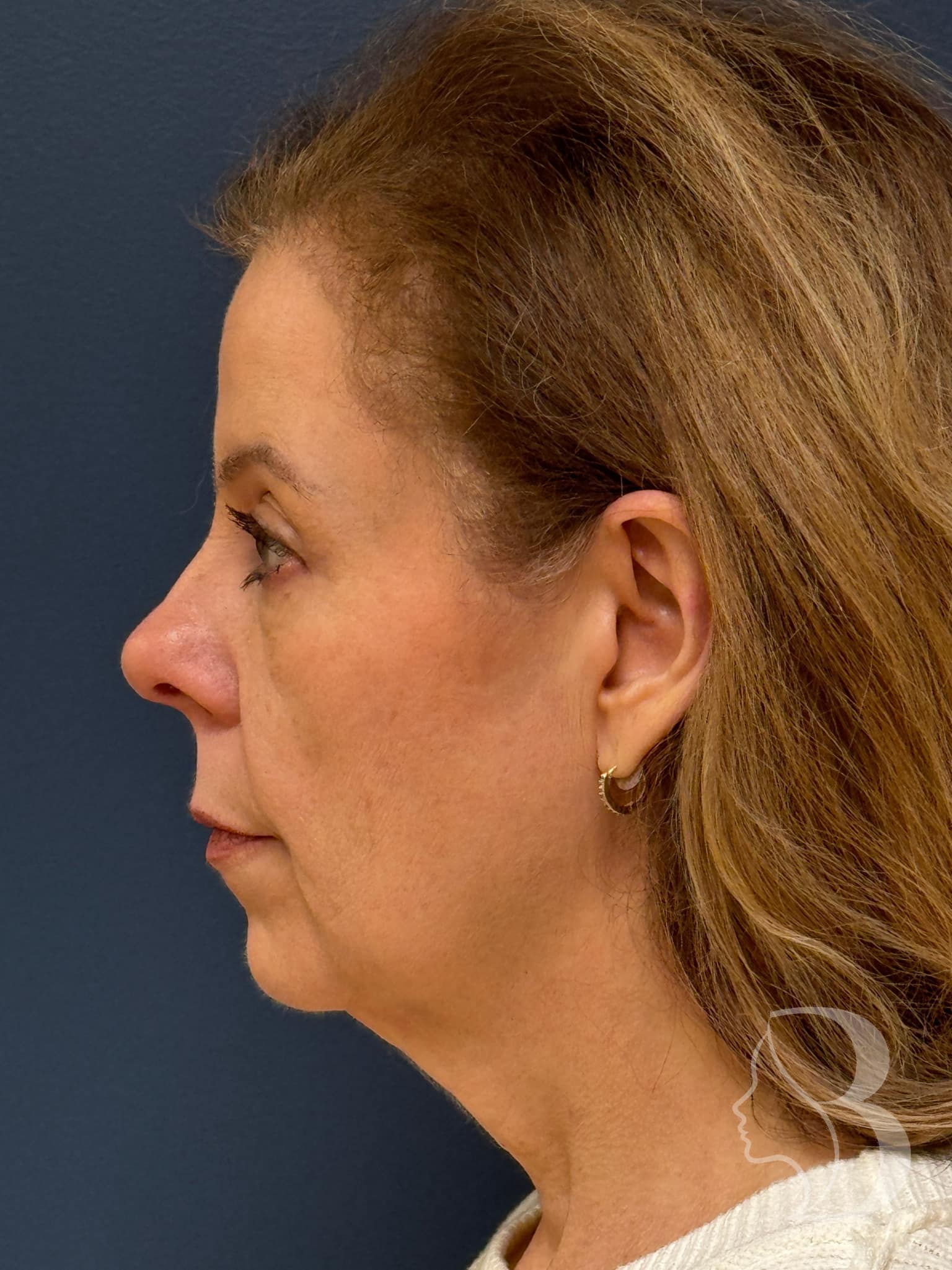
Both cases above were performed in Morristown under local anesthesia with moderate sedation. Fat transfer to the cheeks and malar region was performed at the same operative visit as the deep plane facelift — no staging, no second procedure.
Fat Transfer vs. Fillers: Why Your Own Fat Wins
Many patients arrive having already tried fillers — Juvéderm, Restylane, Radiesse, Sculptra — for cheek and midface volume. Fillers are an excellent tool for the right patient at the right stage of aging. But for a patient who is having a facelift, the comparison is lopsided:
- Duration: Hyaluronic acid fillers last six to eighteen months. Fat transfer, once the grafted fat has survived, is permanent or near-permanent. The patient does not need to return every year to maintain their volume.
- Material: Fillers are synthetic or semi-synthetic materials that the body will eventually break down. Fat is the patient’s own tissue, with zero risk of foreign-body reaction and natural integration into the surrounding anatomy.
- Cost over time: Repeated filler injections, when tabulated over a decade, often cost more than a one-time fat transfer performed at the time of a facelift. For a patient having surgery anyway, the marginal cost of fat transfer is modest.
- Natural appearance: Well-executed fat transfer produces a softness and natural movement that fillers cannot fully replicate, particularly in the cheeks and temples where larger volumes are placed.
The one area where fillers retain an advantage is precision: small, targeted corrections to the lips or specific lines are better addressed with a fine-gauge filler than with fat. But for the mid-face volume deficits that typically accompany facelift candidacy in North Jersey patients, fat transfer is the superior choice.
Am I a Good Candidate for Fat Transfer with a Facelift in North Jersey?
Most patients who are facelift candidates also benefit from fat transfer if they have noticeable volume loss in the cheeks, temples, or under-eye area. The best candidates:
- Have visible midface flatness or hollow cheeks in photos that go back a decade or more
- Notice a “tired” or “sunken” look that fillers have addressed temporarily but that they’d like to solve more permanently
- Have sufficient donor fat — even slim patients typically have enough from the abdomen or thighs for facial grafting
- Understand that fat transfer results stabilize at three to six months and that a small touch-up session is occasionally needed
Patients who do not need fat transfer with their facelift are those with well-maintained facial volume who primarily need lifting. Performing fat transfer when volume is already adequate creates overfilling. A careful consultation with computer simulation — available at Dr. Rafizadeh’s Morristown office — is the best way to determine whether fat transfer belongs in your plan.
Questions to Ask Any Plastic Surgeon in North Jersey About Fat Transfer
If you are interviewing surgeons for a facelift in Morristown, Summit, Chatham, Madison, Short Hills, Mendham, or anywhere across Northern New Jersey, these questions will reveal whether the surgeon is experienced in combined facelift and fat transfer:
- How many cases per year do you perform where fat transfer is combined with a facelift at the same operation?
- Do you inject fat before or after the facelift dissection, and why?
- What is your expected survival rate for transferred fat, and how do you account for resorption in your injection volume?
- Where specifically do you place fat in the face, and how much per side on average?
- Do you use a blunt cannula or sharp needle for injection, and at what depths?
- What is your protocol if a patient needs a touch-up after initial fat resorption?
A surgeon who has been performing fat transfer with facelifts for decades will answer all of these in specific, technical terms. Vague answers about “restoring volume naturally” without specifics on technique, volume, and sequencing should prompt further questions.
Common Questions About Fat Transfer & Facelift in North Jersey
How long does fat grafting to cheeks last?
Fat grafting to the cheeks is long-lasting and, for most patients, permanent. After an initial resorption phase over three to six months, the surviving fat cells integrate with the native tissue and establish a blood supply. They behave like any facial fat — they respond to modest weight fluctuations but do not dissolve. Most Morristown patients Dr. Rafizadeh has followed for five or more years after combined facelift and fat transfer retain their cheek volume without any supplementation.
Does facial fat grafting look natural?
Yes — when done with the right technique and appropriate volume. Fat is soft tissue that moves with facial expression and integrates seamlessly into the surrounding anatomy. The key is layered, small-aliquot injection that distributes fat evenly rather than placing large boluses. Dr. Rafizadeh’s philosophy in North Jersey is to restore what youth had, not to add volume beyond what the face had at its best. The result is fullness that looks like your face at a younger age, not like filler.
How long does it take to look normal after facial fat transfer?
Most of the puffiness from fat transfer resolves by two to three weeks. When done at the same time as a facelift, the two recoveries overlap — the fat-transfer swelling in the central face often lasts a few days longer than the facelift swelling at the jawline. Most Northern New Jersey patients are comfortable at social events and low-key activities by the end of week two, with residual swelling that is visible mainly in direct bright light through week four. The final fat result — once resorption stabilizes — is clear by month three to six.
What are the disadvantages of facial fat grafting?
The main limitation is variability in survival — typically 30 to 60 percent of transferred fat is reabsorbed, and predicting exactly how much any individual will retain is not yet possible. Experienced surgeons account for this by injecting a moderate surplus. Occasionally a touch-up session is needed. The donor-site liposuction adds minor bruising at the harvest location. And in unskilled hands, fat can be injected unevenly or in excess. These limitations are manageable but should be understood going in.
Can fat grafting go wrong?
Fat grafting can have complications, though serious ones are rare in experienced hands. The most common issue is asymmetric retention or lumpiness from uneven injection. Over-injection creates an unnatural puffy appearance. Vascular complications — rare but serious — are prevented by using blunt-tipped cannulas and slow injection technique. Dr. Rafizadeh has performed facial fat grafting for decades in Morristown, and complication rates in properly selected and technique-conscious cases are very low.
Is fat transfer better than fillers for the face?
For patients having a facelift, yes — fat transfer is better than fillers for volume restoration in almost every respect. It uses your own tissue, lasts significantly longer (often permanently versus months for filler), integrates naturally, and is done under the same anesthesia with no additional recovery. Fillers remain the right choice for younger patients or small targeted corrections, but for a facelift patient in North Jersey who also needs midface volume, fat transfer is the preferred and more cost-effective solution over the long term.
Should fat transfer be done before or after a facelift?
In Dr. Rafizadeh’s practice, fat transfer is done at the same time as the facelift — not before or after. Staging requires a second anesthesia, a second recovery, and a second surgical fee, with no clinical benefit. When the facelift dissection is complete and the tissues are in their new position, fat is injected into non-undermined zones of the face. The sequencing ensures that the fat is placed into stable, well-vascularized tissue, supporting good survival rates and a complete, harmonious result from a single operation.
Related Reading From Dr. Rafizadeh’s Blog
Patients in Northern New Jersey researching facelift, fat grafting, and facial rejuvenation options may find these articles from Dr. Rafizadeh useful:
- Deep Plane Facelift in NJ — Dr. Rafizadeh’s Approach
- The Safest Anesthesia for Older Patients: Facelift, Eyelid & Brow Lift Without Dementia Risk
- How to Make a Facelift Effective With a Quick Recovery in New Jersey
- Facelift in Older Patients: What’s Needed in Northern New Jersey
- How Long After a Facelift Can I Exercise?
- Breast Lift, Fat Transfer & Tummy Tuck at the Same Time in North Jersey
Bottom Line
A facelift that lifts skin without addressing volume loss is solving half the problem. For Northern New Jersey patients who have both — and most facelift candidates do — combining fat transfer at the same operation is the surgically correct, practically efficient, and aesthetically complete approach. Your own fat, placed in small volumes into the cheeks, temples, and tear trough at the time of your deep plane facelift, restores what age removed and ages naturally with you going forward. No filler, however well-placed, replicates that.
If you are considering a facelift in Morristown, Summit, Chatham, Madison, Short Hills, or anywhere across Northern New Jersey, Dr. Rafizadeh will evaluate your specific volume loss during the consultation — including computer simulation — and give you an honest recommendation about whether fat transfer belongs in your plan, and exactly where.
Sources & Further Reading
- Rohrich RJ, Pessa JE. "The fat compartments of the face: anatomy and clinical implications for cosmetic surgery." Plast Reconstr Surg. 2007.
- Coleman SR. "Structural fat grafting." Aesthet Surg J. 1998. — foundational technique description by the originator of modern fat grafting.
- Tonnard P, Verpaele A, Peeters G, et al. "Nanofat grafting: basic research and clinical applications." Plast Reconstr Surg. 2013;132(4):1017–1026.
- Oranges CM et al. "A systematic review of the effectiveness and complications of fat grafting in the facial region." Dermatol Surg. 2020.
- American Society of Plastic Surgeons. "Fat Grafting Overview." ASPS, 2025.
- American Society of Plastic Surgeons. "Facelift (Rhytidectomy) Overview." ASPS, 2025.
Ready to schedule a consultation in Morristown, NJ?
Book a Consultation