
One of the most frequent questions Dr. Farhad Rafizadeh fields in his Morristown consultation room — and one that comes up repeatedly on his RealSelf Q&A page — comes from women several months or years out from a breast augmentation who notice that one breast is starting to feel different from the other.
“I’m about eight months out from my breast augmentation. My right breast is starting to feel firmer than my left, and it looks like it’s sitting a little higher. Is this capsular contracture? What can be done about it?”
The short answer: yes, that combination — new asymmetric firmness with a slightly higher-sitting implant — is the classic early picture of capsular contracture. The longer answer is that it is the most common long-term complication of breast augmentation, that it is treatable, and that the right time to act is now rather than later.
Dr. Rafizadeh’s Short Answer
Every breast implant is wrapped in a thin capsule of scar tissue. That is normal and expected. Capsular contracture is what happens when that capsule decides to thicken and tighten. The risk is small with modern smooth implants placed by careful technique, but it is real, and it is the single most common long-term reason patients come back for breast revision surgery. Early grade I-II disease is easier to address than late grade III-IV disease — so when a North Jersey patient notices new firmness in one breast, the right move is a consultation, not a wait-and-see.
That principle — act early, treat the cause, and prevent recurrence with sound technique — has guided Dr. Rafizadeh’s breast surgery practice in Morristown for more than four decades.
What Capsular Contracture Actually Is
The capsule is not a defect. When any foreign body is placed in human tissue — an implant, a pacemaker, a joint replacement — the body walls it off with a thin layer of collagenous scar. For breast implants, that capsule is what gives the implant its dimensional stability and keeps it in the right anatomical pocket. In the vast majority of patients, the capsule stays thin, soft, and pliable, and the patient never knows it is there.
In a subset of patients, that capsule starts to thicken. The collagen fibers tighten, the capsule shrinks, and it begins to squeeze the implant inside it. The implant doesn’t change — the capsule around it does. As the squeeze progresses, the breast feels firmer, looks more rounded, may ride higher on the chest, and in advanced stages can become painful.
That progression is graded on the Baker scale, which has been the standard clinical vocabulary for capsular contracture since the 1970s.
The Four Baker Grades of Capsular Contracture
| Grade | Feel & Appearance | Typical Recommendation |
|---|---|---|
| Baker I | Breast feels soft and looks completely natural. No visible distortion. The capsule is present but pliable. | Routine follow-up. No intervention needed. |
| Baker II | Breast feels slightly firmer than expected on exam, but appearance is still natural. | Conservative trial: massage protocol, anti-inflammatories, monitoring. |
| Baker III | Breast feels firm and looks visibly distorted — rounded, ball-like, riding high, or asymmetric. Usually not painful. | Surgical revision: capsulectomy and implant exchange. |
| Baker IV | Breast is hard, visibly misshapen, and painful or tender. | Surgical revision is generally recommended without delay. |
The reason the grading matters is treatment selection. Grades I and II can often be managed conservatively. Grades III and IV are surgical indications — the capsule will not soften back on its own once it has reached that level of contraction.
What Causes Capsular Contracture?
The honest answer is that we don’t know the single cause — and there probably isn’t one. Capsular contracture is now understood as a multi-factorial process driven by inflammation in and around the implant pocket. The main triggers identified in the surgical literature are:
- Subclinical infection & bacterial biofilm. Skin bacteria (often Staphylococcus epidermidis) can colonize the implant surface during insertion and form a biofilm. The body cannot fully clear the biofilm and responds with a chronic low-grade inflammatory reaction that thickens the capsule.
- Hematoma or seroma. Blood or serous fluid sitting in the pocket after surgery is a powerful stimulus for inflammation and capsule thickening.
- Bleeding during surgery. Any residual blood in the pocket increases contracture risk — one of the reasons meticulous hemostasis is non-negotiable.
- Textured implant shells. Once thought to reduce contracture, textured implants are now linked to BIA-ALCL (a rare lymphoma) and many have been recalled. Dr. Rafizadeh discusses the ALCL link in detail in his post on breast implant ALCL.
- Radiation therapy. Breast irradiation, typically in the reconstructive setting, dramatically increases contracture risk.
- Smoking. Nicotine impairs healing and increases the inflammatory response in the implant pocket.
- Implant plane. Sub-glandular (above the muscle) placement is associated with somewhat higher contracture rates than submuscular placement.
The practical takeaway: most of these triggers are within the surgeon’s control on the day of surgery. That is why prevention starts in the operating room.
How Dr. Rafizadeh Prevents Capsular Contracture in Morristown Breast Augmentations
Prevention is not a single trick — it is a discipline of small, repeated decisions throughout the operation. Dr. Rafizadeh’s standard protocol in his accredited Morristown outpatient facility includes:
1. Meticulous Hemostasis — Zero Bleeding Before the Implant Goes In
The pocket is dissected, every small vessel is cauterized, and the pocket is inspected dry before the implant is placed. Even minor residual bleeding raises the long-term contracture risk.
2. Triple Antibiotic Irrigation of the Pocket
The pocket is irrigated with an antibiotic solution to reduce the bacterial load on the implant surface before insertion. This single step has the best evidence base of any prevention measure in the literature.
3. No-Touch Insertion Technique
The implant is handled as little as possible and inserted without contacting skin or surgical drapes. A funnel-assisted delivery further reduces the chance of skin-bacteria contact with the shell.
4. Smooth Round Implants — Never Textured
Dr. Rafizadeh has never used textured implants in his practice. He didn’t believe they offered a meaningful capsular-contracture benefit even when texturing was in vogue, and the subsequent BIA-ALCL data has validated that decision. Smooth, round implants placed with infection-prevention technique are the safer long-term choice.
5. Implant Brand Selection — Motiva, Allergan, and Mentor
Dr. Rafizadeh works with the three implant manufacturers he trusts most for long-term safety and consistency: Motiva, Allergan, and Mentor. Each brand offers distinct characteristics in terms of gel cohesiveness, shell engineering, and profile options. The choice between them is made case-by-case, based on a patient’s anatomy, tissue quality, and aesthetic goals. During the consultation, Dr. Rafizadeh walks through the specific attributes of each manufacturer and makes a recommendation grounded in the full clinical picture — including which option carries the lowest capsule risk for that patient’s individual anatomy.
6. Submuscular Placement When Appropriate
For most primary augmentation patients, Dr. Rafizadeh places the implant in a partial submuscular plane. The pectoralis muscle covering provides additional camouflage, reduces visible rippling, and is associated with a lower long-term contracture rate.
7. Early-Recovery Activity Protocol
Patients receive a specific protocol for the first six weeks: a defined breast massage routine, activity restrictions tuned to the implant plane, and follow-up checkpoints at one week, three weeks, six weeks, three months, and one year — with longer-interval monitoring after that.
What to Do If You Think You Have Capsular Contracture
For a North Jersey patient noticing new asymmetric firmness months or years after augmentation, the right sequence is straightforward:
- Schedule a consultation — don’t wait. Early grade I-II contracture is much easier to manage than late grade III-IV disease. Time is not on the patient’s side once the capsule begins to thicken.
- Bring your operative records if possible. Implant brand, fill, size, plane, and incision approach all inform the revision plan.
- Be honest about symptoms. Asymmetric firmness, change in shape, pain, recent illness, trauma, or new procedures (dental, vaccinations) all matter to the diagnostic picture.
- Imaging may be ordered. Ultrasound or MRI can confirm capsule thickening, rule out rupture, and clarify the surgical plan.
Treatment Options: From Conservative to Surgical
The treatment depends entirely on the grade and the underlying cause.
Grade I & II — Conservative Trial
For early contracture without distortion, Dr. Rafizadeh may recommend a trial of intensified implant displacement exercises, anti-inflammatory medication, and in selected patients a leukotriene inhibitor such as zafirlukast (Accolate) or montelukast (Singulair). The evidence for these medications is mixed but they are well tolerated and have softened some early capsules.
Grade III & IV — Surgical Revision
Once the capsule is contracted enough to distort the breast or cause discomfort, the established treatment is surgical revision. The components of a properly done revision are:
- Capsulectomy. The thickened capsule is removed in continuity. Simply opening the capsule and leaving it (capsulotomy) has a high recurrence rate and is generally avoided in primary revisions.
- Fresh pocket. The pocket is re-defined — sometimes in a different plane (sub-glandular to sub-muscular) to take advantage of better long-term contracture rates with submuscular placement.
- New sterile implant. The old implant is discarded and a new, sterile implant is used. The brand, profile, and size are re-evaluated based on current tissue characteristics.
- Antibiotic irrigation and no-touch insertion. The same prevention principles apply — arguably more so, since this patient has already proven her biology can mount a contracture response.
- Sometimes acellular dermal matrix (ADM). In recurrent contracture or radiated patients, ADM can be used to reinforce the new pocket and reduce recurrence risk.
Where appropriate, revision can be combined with a breast lift — particularly if the contracture has been long-standing and the tissue has stretched or descended. Dr. Rafizadeh covers the principles of staged breast revision in his post on breast lift with implant exchange in one stage.
What This Looks Like in Real North Jersey Patients
The cases below were each performed in Morristown by Dr. Rafizadeh — smooth round implants, careful pocket dissection, antibiotic irrigation, no-touch insertion. They illustrate the long-term result the prevention protocol is designed to protect.
Patient Before & After
View Full Gallery →


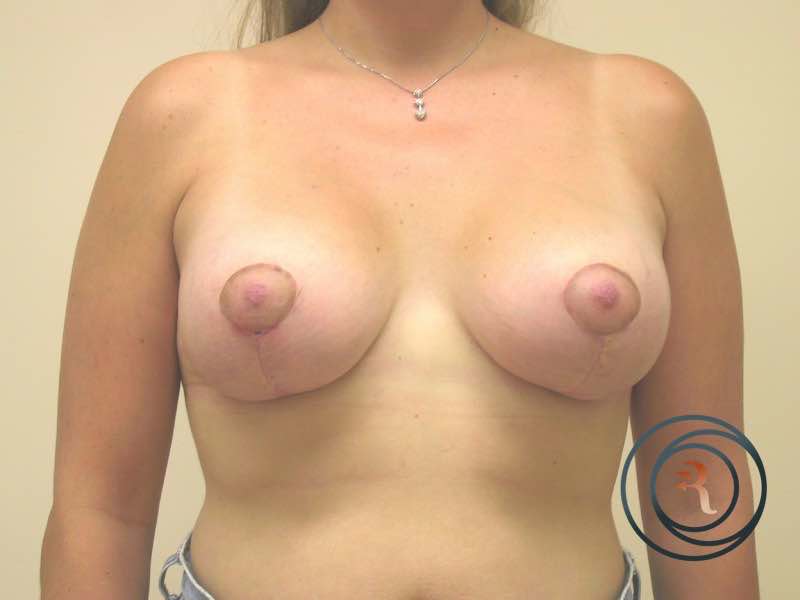
Both patients above were augmented with smooth round implants placed in a partial submuscular plane using triple antibiotic irrigation and a no-touch insertion technique — the prevention protocol Dr. Rafizadeh uses in every Morristown breast augmentation.
Questions to Ask Any Plastic Surgeon About Capsular Contracture
If you are evaluating surgeons in Morristown, Summit, Chatham, Madison, Short Hills, Bernardsville, Mendham, Florham Park, or anywhere in Northern New Jersey, the prevention conversation tells you almost as much about the surgeon as the augmentation conversation. Useful questions:
- What is your specific protocol to prevent capsular contracture — antibiotic irrigation, no-touch insertion, hemostasis standards?
- Do you use smooth or textured implants? Why?
- Which implant manufacturers do you work with, and why? How do you choose among Motiva, Allergan, and Mentor for a given patient’s anatomy?
- Where do you place the implant — sub-glandular, partial submuscular, or fully submuscular — and why for my anatomy?
- What is your post-operative massage and activity protocol?
- What is your long-term re-operation rate for capsular contracture in your own patients?
- If I develop capsular contracture, how do you treat it — capsulectomy vs. capsulotomy, fresh pocket, plane change?
Common Questions Patients Search About Capsular Contracture
What are the first signs of capsular contracture?
The earliest sign is usually a subtle change in feel — one breast becomes a little firmer than the other, often before any visible change. Over weeks to months, the affected breast may start to sit slightly higher on the chest, look a bit more rounded, or feel tight when pressed. Visible distortion and pain come later. Any new asymmetric firmness in the months or years after augmentation deserves an in-office evaluation.
How common is capsular contracture after breast augmentation?
For modern smooth silicone implants placed by an experienced surgeon using infection-prevention technique, the long-term rate of clinically significant capsular contracture (Baker grade III-IV) is generally in the single-digit percent range over the life of the implant. Rates are higher with textured implants, sub-glandular placement, after radiation, and after hematoma or seroma. The prevention steps Dr. Rafizadeh uses in every Morristown breast augmentation are designed to keep the rate at the low end of that range.
How quickly does capsular contracture progress?
It varies. Some cases progress over weeks — particularly when the trigger is a hematoma, a seroma, or a subclinical infection. Others smolder for years before reaching grade III. Once a contracture has reached grade III with visible distortion, it almost never softens back on its own — which is why early evaluation matters.
How do you fix capsular contracture in breast implants?
For early grade I-II contracture, conservative measures — intensified massage, anti-inflammatories, and sometimes a leukotriene inhibitor like zafirlukast — may soften the capsule. For grade III-IV contracture, the established treatment is surgical revision: capsulectomy (removing the thickened capsule), creation of a fresh pocket (sometimes in a different plane), and exchange of the implant. Simply opening the capsule and leaving the same implant in place has a high recurrence rate and is generally avoided.
What does the start of capsular contracture feel like?
Most patients describe the earliest stage as the affected breast feeling “just a little firmer” than the other one, with a sensation of tightness or fullness that doesn’t quite match. It is rarely painful at this stage. The asymmetric firmness is the tell-tale finding — bilateral firmness can be normal postoperative swelling, but one-sided new firmness months after surgery is suspicious for capsule change.
What are the odds of getting capsular contracture?
Across modern studies, the long-term incidence of clinically significant Baker grade III-IV contracture with smooth silicone implants and good surgical technique is generally in the low single-digit percent range. Saline implants are similar. Sub-glandular placement, textured implants, post-radiation tissue, and any post-operative hematoma or seroma all push the rate higher. Submuscular placement, antibiotic irrigation, no-touch insertion technique, and careful hemostasis all push it lower.
Does massage prevent capsular contracture?
Implant displacement exercises — gentle massage that moves the implant within the pocket — can help maintain pocket size and may reduce the likelihood of an unfavorable capsule pattern, particularly in the first three to six months after surgery. Massage does not guarantee prevention. Dr. Rafizadeh provides a specific massage protocol after surgery and reviews it during follow-up visits at his Morristown office.
Related Reading From Dr. Rafizadeh’s Blog
Northern New Jersey patients researching breast augmentation and revision may find these articles useful:
- How Long Do Breast Implants Last? When to Replace Them — North Jersey
- Anaplastic Large Cell Lymphoma (ALCL) Associated With Breast Implants Explained
- Smooth vs. Textured Breast Implants — A Choice in Morristown, New Jersey
- What Is the Best Breast Implant for You?
- Breast Lift & Exchange of Implants in One Stage in Morristown
- Choosing Between Silicone or Saline-Filled Breast Implants
Sources & Further Reading
For patients who want to verify the clinical claims in this post or read more deeply, the most authoritative public sources on capsular contracture are:
- U.S. Food & Drug Administration — Risks and Complications of Breast Implants. Includes Baker grading guidance, contracture as a reoperation indication, and the most recent regulatory positions on textured implants and BIA-ALCL.
- American Society of Plastic Surgeons — What Is Capsular Contracture and How Can It Be Treated?. Patient-facing overview, including the role of submuscular placement in reducing contracture risk.
- Haas E, et al. — Capsular Contracture After Breast Augmentation (PMC, 2025). Peer-reviewed review of the current evidence on pathogenesis, grading, and treatment.
- Susini P, et al. — Advances on Capsular Contracture: Prevention and Management (PMC, 2023). Comprehensive review of prevention strategies including antibiotic irrigation, no-touch technique, and pocket-handling principles.
- Breastcancer.org — What Is Capsular Contracture and How Is It Treated?. Plain-language patient overview, particularly useful for reconstruction patients evaluating their options.
Dr. Rafizadeh’s recommendations in this post are consistent with the consensus in these sources, with clinical preferences informed by his own 40+ years of breast surgery experience in Morristown.
Bottom Line
Capsular contracture is the most common long-term reason a breast augmentation patient comes back to the operating room — but it is not common, and with the right prevention protocol it is uncommon. For North Jersey patients who notice new firmness, change in shape, or a slightly higher-sitting implant months or years after augmentation, the right move is an early consultation. Grade I-II disease can often be quieted with conservative measures. Grade III-IV disease is a surgical problem with a well-established surgical solution — capsulectomy, fresh pocket, new implant, infection-prevention technique — and a low recurrence rate when done thoughtfully.
If you have implants and you’re noticing a change, or if you are considering a primary breast augmentation in Morristown, Summit, Chatham, Madison, Short Hills, Bernardsville, or anywhere across Northern New Jersey, Dr. Rafizadeh is happy to walk through your specific anatomy, implant history, and revision options during a consultation.
Concerned about capsular contracture? Schedule a consultation in Morristown, NJ.
Book a Consultation