
One of the most practical, well-reasoned questions Dr. Farhad Rafizadeh receives from women planning their first post-pregnancy plastic surgery — and one that appears recurrently on his RealSelf Q&A page — is whether the breasts and the abdomen can be addressed in a single surgery, without implants.
“Can I get a breast lift with fat transfer at the same time as my tummy tuck? I do not want implants. I’m overall happy with my size, but I would like a little more perkiness and perhaps more upper fullness and cleavage. Would I benefit from a lift, and if so, what kind?”
The short answer is: yes, this combination is one of the most elegant mommy makeover designs in plastic surgery — provided the patient is healthy, the surgeon is experienced in all three components, and the operating facility is set up for combined cases. For North Jersey women in Morristown, Summit, Chatham, Madison, Short Hills, and the surrounding towns who want to look like themselves again after pregnancy and breastfeeding without committing to implants, this is often the single best operation available.
Dr. Rafizadeh’s Short Answer
The tummy tuck is going to remove fat anyway. Instead of discarding it, we can harvest it carefully, purify it, and use it to restore the upper-pole fullness and cleavage that pregnancy and breastfeeding deflated. Add a well-designed breast lift to reposition the nipple and reshape the breast, and the patient gets the lift, the volume, the flat abdomen, and the contoured waist — all in one anesthetic, one recovery, and without any implant to maintain. For the right patient in Northern New Jersey, this is the procedure I most enjoy designing.
Three procedures, one operation, and a single recovery. That economy is part of why this combination has been a quiet workhorse of Dr. Rafizadeh’s Morristown practice for decades.
Why This Combination Makes Anatomic Sense
The pregnancy-and-breastfeeding sequence does very specific things to a woman’s body:
- The abdomen stretches, the rectus muscles separate (diastasis), and the lower-abdominal skin loses elasticity. Diet and exercise will not reverse these changes once the soft tissue has stretched past its recoil limit.
- The breasts swell during pregnancy and lactation, then deflate. The skin envelope is left larger than the gland that remains inside it. The result is laxity, lower nipple position, and loss of the upper-pole fullness women associate with their pre-pregnancy figure.
- The flanks and lower trunk often retain pockets of stubborn fat that respond poorly to diet.
Each of these has a precise surgical correction. A tummy tuck removes the stretched lower-abdominal skin and repairs the muscle separation. A breast lift removes the excess breast skin and repositions the nipple. Fat grafting borrows tissue from areas of excess (often the flanks during the tummy tuck) and places it where the breast has deflated — the upper pole and the medial cleavage. Combining the three in one surgical plan is the closest plastic surgery comes to a complete “un-doing” of the post-pregnancy changes without using an implant.
How Dr. Rafizadeh Sequences the Operation
The sequencing matters. In Dr. Rafizadeh’s Morristown operating room, a combined breast lift + fat transfer + tummy tuck usually follows this order:
1. Markings Are Drawn While the Patient Is Standing
Breast lift markings and tummy tuck markings must be drawn with the patient upright, because gravity is part of the design. Once the patient is on the table the breast and skin distribution change, and you lose the truthful starting point.
2. Fat Is Harvested First
With the patient comfortably positioned, low-suction liposuction is used to harvest fat from the flanks, the upper hips, and any abdominal area that is not part of the tummy tuck resection itself. Harvesting first preserves the most delicate fat cells for transfer; using gentle, low-pressure technique is what differentiates a 70% take rate from a 30% take rate.
3. The Breast Lift Is Performed and Fat Is Grafted
The breast lift pattern is chosen based on how much skin needs to be removed and how far the nipple needs to be elevated — ranging from a peri-areolar (Benelli) lift for mild laxity to a vertical or anchor pattern for more significant ptosis. After the lift is closed, purified fat is grafted in small aliquots into the upper pole and medial cleavage of each breast, in multiple tissue planes, to maximize survival and to soften the upper transition.
4. The Tummy Tuck Is Performed Last
The abdominoplasty is then performed in the standard fashion — lower abdominal skin and fat resection, rectus muscle repair if indicated, umbilicus repositioning, and closure with progressive tension sutures to limit fluid collections. Doing the tummy tuck last allows the patient’s flank fat to have already been harvested, and means the abdomen is closed under final, optimized tension at the end of the case.
How Much Volume Can Fat Transfer Realistically Add to the Breast?
This is the question that determines whether a patient is a candidate for fat-transfer-only or whether implants are still in play. Honest numbers:
- Roughly half a cup to one cup size of increase per breast per session, in most patients.
- Fat survival is typically 50–70% with refined technique. Surviving fat is permanent.
- A second session 4–6 months later can add another modest increment if the patient wants more, although most patients in Dr. Rafizadeh’s practice are happy with one session.
- Volume comes from donor availability. A very lean patient may not have enough harvestable fat to produce a meaningful breast result. A patient with moderate abdominal and flank fullness has plenty.
If a North Jersey patient is asking for a true two-cup augmentation, more dramatic upper-pole projection, or has a very small frame with limited donor fat, an implant-based breast augmentation is the more honest recommendation. Dr. Rafizadeh has performed thousands of implant cases and is comfortable advising either pathway.
Who Is — and Isn’t — a Good Candidate for the Combined Operation
Combination cases are not for everyone. Dr. Rafizadeh screens carefully on the following:
Good Candidates
- Healthy non-smoker, no significant cardiac or pulmonary disease.
- BMI in a reasonable range (Dr. Rafizadeh sets this individually based on health and body habitus).
- Diastasis recti and lower-abdominal skin laxity that warrant a tummy tuck.
- Mild-to-moderate breast ptosis with deflation — the breast envelope is larger than the gland that remains.
- Adequate donor fat at the flanks and lower trunk.
- Realistic about volume gain (about half a cup to one cup per breast).
- Done having children (or comfortable that future pregnancy could change the result).
- Able to arrange seven to ten days of household and childcare help during the early recovery.
Better Suited to Staged Procedures
- Smokers (must stop completely for at least four to six weeks before and after).
- Diabetes that is not well-controlled.
- Prior major abdominal surgery with extensive scarring.
- Significant medical comorbidities — cardiac, pulmonary, clotting.
- BMI above the threshold Dr. Rafizadeh sets for combined cases.
- Patients who want a dramatic two- to three-cup breast augmentation — better served by lift plus implants, possibly staged.
For patients in either category, Dr. Rafizadeh will often recommend a staged plan — tummy tuck first, breast work three to six months later, or vice versa — rather than push a combination that adds risk without adding benefit.
Anesthesia, Facility, and Safety for Combined Cases
The combined operation is performed in a fully accredited outpatient surgical facility in Morristown with a board-certified anesthesia provider present throughout the case. Continuous monitoring of heart rate, blood pressure, oxygen saturation, end-tidal CO2, and core temperature is in place from start to finish. For combined mommy makeover cases, Dr. Rafizadeh also uses:
- Sequential compression devices on the legs to lower the risk of deep vein thrombosis (DVT) during longer cases.
- Active warming to keep core temperature stable through the procedure.
- TAP block (transversus abdominis plane block) for long-acting abdominal pain control after the tummy tuck — described in more detail in this dedicated blog post.
- Progressive tension sutures at the tummy tuck closure to reduce fluid collections (seromas) and shorten drain time.
Out-of-town patients traveling from Manhattan, Westchester, Bergen County, Hoboken, or Jersey City can review the office’s travel arrangements on the out-of-town patient page.
What the Results Look Like in Real Patients
Both of the cases below were performed in Morristown as part of combined mommy makeover plans. They show the kind of natural, balanced result Dr. Rafizadeh designs around — lifted but not over-tightened, fuller but not implant-obvious, and a contoured trunk to match.
Patient Before & After
View Full Gallery →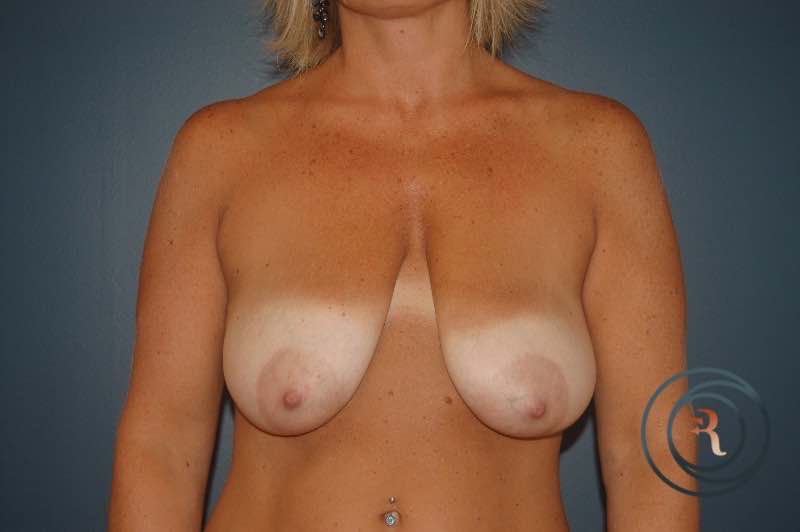
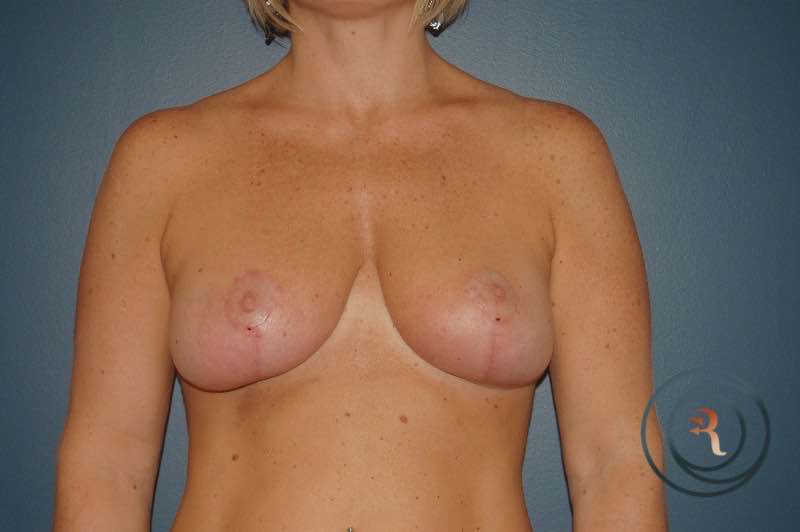

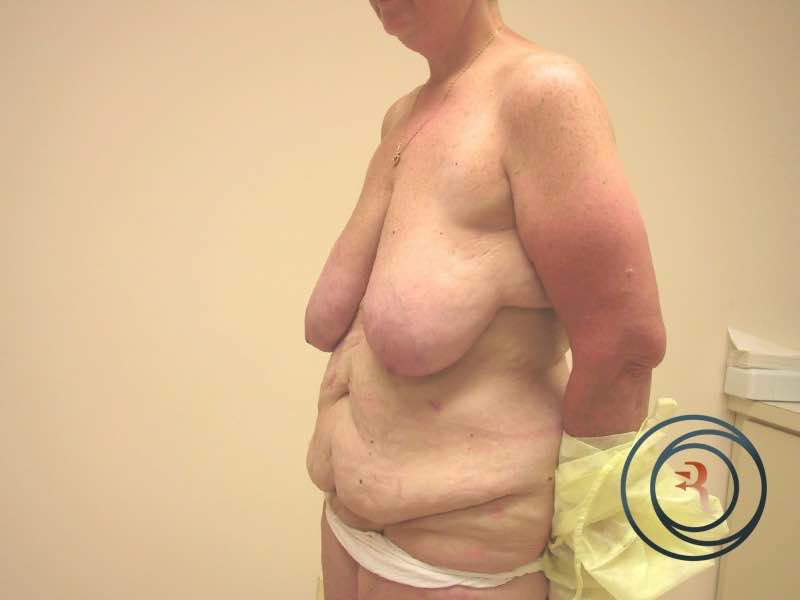
Both patients above were operated on in Morristown. The breast lift and the tummy tuck components are shown separately for clarity; in combined cases the fat removed from the trunk is the fat that restores breast volume.
Recovery: What the First Six Weeks Actually Look Like
Patients in Summit, Chatham, Madison, and Short Hills often ask whether combining three procedures means three recoveries stacked together. It does not — one recovery covers all three, and it is dominated by the tummy tuck.
- Day 1–3: Walking with a forward bend to protect the abdominal closure. IV-fluid hydration, anti-nausea medication, oral pain control. One or two drains in the abdomen. Sleeping on the back with pillows under the knees and behind the head.
- Week 1: Off most prescription pain medication by the end of the week. Drains usually out around day 7–10. Showering permitted once drains are out. No bra pressure on the breasts during the early weeks — a soft surgical bra only.
- Week 2–3: Back to desk work, light driving (when off narcotics), and child-supervision tasks that don’t involve lifting. Still no lifting more than ten pounds.
- Week 4–6: Resume light cardio. The fat graft has settled by this point and a realistic sense of final breast size emerges. Most patients are comfortable in fitted clothing.
- Three months: Cleared for unrestricted exercise. Scars are pink but maturing. Final shape and volume continue to refine for several more months.
For more on the abdominal recovery specifically, see Dr. Rafizadeh’s posts on tummy tuck recovery and scar care and tummy tuck recovery in Morristown, New Jersey.
Combined Surgery vs. Staging: How to Decide
If the patient is a good candidate medically, the case for combining is strong:
- One anesthesia. Each anesthetic carries its own (small) risk. One exposure beats two.
- One recovery. Time off work and away from family obligations is consolidated.
- Lower total cost. Operating room, facility, and anesthesia fees are paid once.
- The fat that becomes the breast volume would otherwise be discarded. Combining is the only sequence in which this is even possible — it is not an option in staged cases.
- Cohesive aesthetic plan. The breast and trunk are designed against one another rather than independently.
If the patient is not a clean candidate medically, the case for staging is stronger:
- Shorter anesthetic time per case lowers risk in patients with cardiac or pulmonary concerns.
- Each procedure gets a clean recovery window.
- The second-stage plan can be refined based on results of the first stage.
Dr. Rafizadeh is comfortable with either pathway. The right answer is whichever one matches the patient’s health profile and life situation.
Questions Patients Should Ask Any Plastic Surgeon in North Jersey About This Combination
If you are interviewing surgeons in Morristown, Summit, Chatham, Madison, Short Hills, Bernardsville, Mendham, Florham Park, or anywhere in Northern New Jersey for a mommy makeover with fat transfer, the conversation about combination versus staging is more important than the marketing photos. Useful questions:
- How many combined breast lift + fat transfer + tummy tuck cases do you do per year personally?
- What is your patient selection threshold — BMI, comorbidities, smoking history?
- Where is the surgery performed, and what is the facility’s accreditation?
- Who is the anesthesia provider, and what are their credentials?
- What is your protocol for DVT prevention on longer cases?
- What fat-harvesting technique do you use, and what is your typical fat survival rate?
- How do you handle the situation if intraoperative findings suggest combining is no longer safe? (A surgeon who can’t answer this should give pause.)
- What is your plan if I want more breast volume after the fat settles?
A surgeon who has done this combination for decades will answer these in concrete, specific terms — with numbers, names of facilities, and clear protocols. A surgeon who improvises will deflect.
Common Questions Patients Search About Combining Breast Lift, Fat Transfer & Tummy Tuck
Is it safe to do a tummy tuck and breast lift at the same time?
For a healthy non-smoker with no significant medical issues, the combination is well-established and routinely performed by experienced plastic surgeons. The risk profile depends on patient selection, surgeon experience, and facility accreditation far more than on the number of procedures. Dr. Rafizadeh combines these operations regularly in Morristown when the patient is a good medical candidate, and recommends staging when they are not.
Should I do a breast lift or tummy tuck first if I'm staging them?
When the procedures are staged rather than combined, either order works. Most patients in Northern New Jersey opt to address whichever area bothers them more first. There is no biological reason to do one before the other, although doing the tummy tuck first does eliminate the option of using its discarded fat for the breasts later. Allow at least three to six months between stages for full recovery.
Does a mommy makeover include fat transfer?
Not by definition — “mommy makeover” is a loose marketing term for any combination of breast and abdominal procedures done together after pregnancy. Fat transfer can absolutely be included, and in Dr. Rafizadeh’s practice it often is, because the tummy tuck creates a natural source of donor fat. Patients who want breast volume restored without implants are the best candidates for adding fat transfer to the combination.
What is the best age for fat transfer to the breasts?
There isn’t a precise “best” age — what matters is body status. Most candidates are women in their thirties through fifties who have completed childbearing, are at or near their stable weight, and have enough donor fat at the flanks and abdomen. Younger patients can be candidates if their breast deflation is significant; older patients are often excellent candidates because they appreciate the natural feel of fat over an implant. Health status, not age on a calendar, drives the decision.
How long does a tummy tuck and breast lift surgery take?
A combined breast lift and tummy tuck typically takes four to five hours of operating time. Adding fat harvest and transfer pushes the total closer to five or six hours. Total anesthetic time is one of the safety variables Dr. Rafizadeh tracks carefully, and is one reason patient selection matters — a fit non-smoker handles a five-hour case very differently than a patient with cardiac or pulmonary disease.
What is the hardest cosmetic surgery to recover from?
Among the procedures discussed here, the tummy tuck dominates recovery effort. The muscle repair and lower abdominal closure require the patient to walk slightly bent forward for the first one to two weeks, restrict lifting for six weeks, and sleep on the back. The breast lift and fat transfer recovery sit comfortably underneath that envelope — they add little beyond the tummy tuck’s pace. Most patients are surprised that combining three procedures doesn’t triple the recovery.
What does a tummy tuck look like 20 years later?
With stable weight and reasonable activity, the abdominal contour and muscle repair from a well-done tummy tuck hold up remarkably well long-term. Patients can expect the scar to fade significantly, the abdominal wall to remain flatter than pre-surgery, and the umbilicus to retain its repositioned shape. Aging skin can develop some new laxity over decades, but the structural improvements from muscle repair and skin resection are durable. Pregnancy after a tummy tuck can stretch the result and is best avoided.
Related Reading From Dr. Rafizadeh’s Blog
North Jersey patients researching combined breast and abdominal procedures may find these articles useful:
- Shaping the Lower Trunk and Buttocks With Lipo-Sculpting and Fat Grafting
- Extended Tummy Tuck in New Jersey
- Tummy Tuck Recovery in Morristown, New Jersey
- TAP Block for Post-Tummy-Tuck Pain Control
- Breast Lift and Implant Exchange in One Stage in Morristown
- Different Patterns of Breast Lift and Mastopexy in NJ
- Quick Recovery After Breast Augmentation in New Jersey
Bottom Line
For the right Northern New Jersey patient, combining a breast lift with fat transfer and a tummy tuck in one surgery is one of the most elegant operations in plastic surgery. The fat removed during the tummy tuck becomes the volume that restores the breasts. The lift repositions and reshapes. The abdominal repair flattens and tightens. One anesthetic, one recovery, no implant, and a result that reads as natural rather than operated.
The decision to combine or to stage is driven by health status, body habitus, donor fat availability, and breast-volume goals — not by enthusiasm. If you are considering a tummy tuck, a breast lift, or a fat transfer in Morristown, Summit, Chatham, Madison, Short Hills, or anywhere across Northern New Jersey, Dr. Rafizadeh is happy to walk through your specific anatomy, health history, and goals during a consultation — and to show you, on a personalized computer simulation, what your combined or staged plan could look like.
Ready to schedule a consultation in Morristown, NJ?
Book a Consultation